Saint Moses the Black

Saint Moses the Black

Popular Posts
-
The Link: http://www.orthodox-christianity.com/?p=1017
-
This is from the podcast Speaking the Truth in Love by Fr. Thomas Hopko Great And Holy Week - Part 1: Play Audio Great and Holy Friday: Pla...
-
You can read the latest edition online. http://www.antiochian.org/sites/antiochian.org/files/JAN%202009%20WORD.pdf JNORM888
-
As seen from the Theologica forums. Brian Leffert said: "Hello Inorm 888, 1) Paul is making a case that something is "not of ours...
-
As seen from the website : "This week Marina talks about Death to the World and the trip they made to Cornerstone Christian Music festi...
-
This is from the podcast Frederica Here and Now by Kh. Frederica Mathewes-Green As seen from the website : "Frederica interviews a con...

Saint John the Theologian

Saint John the Theologian
Facebook Badge

Subscribe


 Posts
All Comments
Posts
All Comments

An excellent read
 6:28 PM |
  Posted by
Jnorm |
Posted by
Jnorm |


Looking Toward Rome
quote:
"Regarding my personal views on the relationship between the Catholic and Orthodox Churches, I think Orthodoxy (in America at least) has understandably (though unwisely) oriented itself relative to American Protestantism. For example, the National Council of Churches has historically been dialog partner with the Church as we have tried to pursue our shared vocation as Orthodox Christians here in America. The practical result is that–despite our dogmatic conservativism–we have as a group adopted a relatively liberal attitude and have done so to our harm. (And to be clear, I mean “liberal” in the contemporary not classical sense of the term.)
Thanks to the recent influx of new Orthodox Christians over the last 20 or so years, there has been a move away from liberal Protestantism as a partner and toward Evangelical Christianity. While I welcome the move away from mainline Protestantism, I’m not convinced that the move toward Evangelical Christianity is necessarily any better for the Church. In both cases, albeit first from the left and now the right, we have adopted a largely Protestant model of in all areas of Church life. Outreach and evangelism, parish and diocesan governance and seminary education are all markedly Protestant.
While I don’t want to say our conversation with the Protestant world was all bad–it certainly isn’t–it has caused Orthodoxy parish life in America to take on a markedly congregational tone. This is more than just a matter of who chairs parish council meeting."
To read the rest please visit the link.
and
Looking Toward Rome, Part 2
quote:
"As for catechesis, I taught theology at a Catholic university for 2 years. While I liked the students, I really disliked teaching there. First the students as group had almost no grasp of the catechism. It was so bad that together with a Protestant minister who also taught there, I asked if the department would consider at least offering a class based on the Catechism of the Catholic Church. No such course was offered.
Worse though, was the faculty intentionally undermining the Catholic faith in the classroom and out of it. Invited speakers who ridiculed the idea that only men could be priests, faculty members who advocated for the establishment of pro-gay rights group (which they got), and a cheapening of the Eucharist along the lines that Fr Stephen Freeman discussed on his blog a sign of Jesus’ absence.
All that said, and as recent events in the OCA suggests, things are not necessarily all that much better in the Orthodox Church. We may not have gone as far down the road as our Catholic brothers and sisters, but we are at the very least standing at a junction that leads down the road they have wandered these last 40+ years. Whether we will follow them into folly is still–humanly speaking at least–an open question. Yes, I do believe that if we take the same or a similar path God will bring us back to ourselves but the damage of our flirtation with foolishness is already bearing the poisonous fruits of adultery."
To read the rest please visit the link
The Differences: Semi-Pelagianism, Rome, Orthodoxy, Arminianism, and Calvinism
-
Thanks, I hope he doesn't mind if I interact with it. I agree with what he said about the first one (Pelagianism). I disagree slightly with the second. And it goes back to what I said previously.
Quote:
Semi-Pelagianism
All people are in the water drowning. They are born drowning. This is the natural habitation of all humanity since the first man and woman jumped into the water. Their legs are cramping and they cannot swim to safety on their own. However, they may desire salvation on their own. Though they cannot attain it, they can call, with a wave of their arm, to God who is eagerly waiting on the edge of the boat. At the first sign of their initiative, God will then throw out the life preserver (grace). If they respond, they will be saved (synergism)."What I underlined is where the common flaw is. If he said "However, some may desire salvation on their own. Though they cannot attain it, they can call, with a wave of their arm, to God who is eagerly waiting on the edge of the boat. At the first sign of their initiative."
If he said it like that then it would of been extremely accurate. If we paint the picture that everyone was able to take the first initiative. Then we distort their view. Saint John Cassian gave the example of the thief on the Cross that was able to take the first initiative, he also said some things about prayer in regards to King David and the first initiative. But he gave other examples of people in Scripture of where that wasn't the case. In his other examples he shows how God took the first initiative. And when we look at what he had to say elsewhere in the infamous 13th constitution/conference we see that he makes use of Augustine's idea of God taking the first initiative. As seen from the Conferences:
Quote:
"From which we clearly infer that the initiative not only of our actions but also of good thoughts comes from God, who inspires us with a good will to begin with, and supplies us with the opportunity of carrying out what we rightly desire: for "every good gift and every perfect gift cometh down from above, from the Father of lights,"But he didn't see that as being the case for all people. When we look at Canon 8 of the local western council of 2nd Orange we see this:
Quote:
CANON 8. If anyone maintains that some are able to come to the grace of baptism by mercy but others through free will, which has manifestly been corrupted in all those who have been born after the transgression of the first man, it is proof that he has no place in the true faith. For he denies that the free will of all men has been weakened through the sin of the first man, or at least holds that it has been affected in such a way that they have still the ability to seek the mystery of eternal salvation by themselves without the revelation of God. The Lord himself shows how contradictory this is by declaring that no one is able to come to him "unless the Father who sent me draws him" (John 6:44), as he also says to Peter, "Blessed are you, Simon Bar-Jona! For flesh and blood has not revealed this to you, but my Father who is in heaven" (Matt. 16:17), and as the Apostle says, "No one can say 'Jesus is Lord' except by the Holy Spirit" (1 Cor. 12:3)."
The Canons of 2nd Orange often attack Saint John Cassian and what he said in various places in the Constitutions/Conferences. But they also rejected double Predestination and they advocated a doctrine of Synergy after Regeneration. As seen from 2nd Orange:
Quote:
"CANON 13. Concerning the restoration of free will. The freedom of will that was destroyed in the first man can be restored only by the grace of baptism, for what is lost can be returned only by the one who was able to give it. Hence the Truth itself declares: "So if the Son makes you free, you will be free indeed" (John 8:36).
As well as in the conclusion:
Quote:
"According to the catholic faith we also believe that after grace has been received through baptism, all baptized persons have the ability and responsibility, if they desire to labor faithfully, to perform with the aid and cooperation of Christ what is of essential importance in regard to the salvation of their soul."And so they brought Free Will back (which is something the Reformed don't do). This is why 2nd Orange is called moderate Augustinianism. Or what I sometimes call Semi-Augustinian.
(going back to read what he said about Rome and EO)
Ok, I slightly disagree with what he said about us.
Quote:
Roman Catholicism and Eastern Orthodoxy
All people are in the water drowning. They are born drowning. This is the natural habitation of all humanity since the first man and woman jumped into the water. Their legs are cramping and they cannot swim to safety on their own. God, standing on the edge of the boat, makes the first initiative by throwing a life preserver to them (prevenient grace). Upon seeing this act, they make a decision to grab a hold (faith) or to swim away. If they grab a hold, God will slowly pull the rope connected to the life preserver. But they must do their part by swimming along with God’s pull (grace plus works; synergism). If at any time they let go or quit swimming, they will not be saved.1.) We don't see anything wrong with visible things or the physical world in general being used as a means of grace. And so what maybe seen as works to some Protestants is seen as Grace to us.
2.) Salvation in both Rome and Orthodoxy is dynamic(I was saved, am being saved, and will be saved). It is not a one time event and so when looking at how we see things one must not only look at what happens before Water Baptism(Regeneration), but also after as well, all the way to our very last breath. For that is when the race is over.
3.) From what I know about Rome, they not only believe in the Augustinian doctrine of Total inability, but they also believe Grace(I'm ignoring the issue of created grace vs uncreated grace) to precede every human animation, and so it would be inaccurate to say grace plus works. As seen from 2nd Orange, we know that the Christian West eventually advocated the view that free will was restored and Rome believes in grace infused works or works prompted by grace. It's a very Augustinian idea. Also, when looking at Rome, you have to be careful for She has multiple schools of thought when it comes to the issue of Grace and Free Will. And so you would have to look at the various schools of thought within Rome. That's if one wants to be as accurate as possible.
a.) Augustinian school of thought
b.) Thomistic school of thought
c.) Congruent school of thought
d.) Molinistic school of thought
4.) Orthodox Christianity doesn't like to use the term Prevenient grace, even though we made use of the Latin term in the 17th century. We don't believe in different species of Grace. And so the differences is in regards to each individuals depth in the Grace of God. We believe God's Grace to not only be everywhere, but we also believe it permeates all things. There is no place in where God's Grace is not. And so there is no place our wills can exist in where His Grace is not already present. And so when we make use of the latin term "Prevenient", it has to be looked at within this context. And so our understanding of Synergy is one of simultaneous co-operation.
Acts chapter 17:27-28 "so that they should seek the Lord, in the hope that they might grope for Him and find Him, though He is not far from each one of us; 28 for in Him we live and move and have our being, as also some of your own poets have said, ‘For we are also His offspring."
However, in every day speech it is difficult to communicate in a way that would express simultaneity.
(Going back to read what he had to say about Arminianism)
Quote: Arminianism
All people are floating in the water dead in their natural condition (total depravity). They are born dead because that has been the condition of humanity since the first man and woman jumped into the water and died (original sin). Death begets death. There must be intervention if they are to be saved. God uses his power to bring every one of them back to life (prevenient grace), but they are still in the water and in danger of drowning. With the regenerated ability to respond to God, now God throws the life preserver to them and calls on them all to grab hold of it. They then make the free-will decision on their own to grab a hold of the life preserver (faith) or to swim away. If they grab a hold, they must continue to hold as God pulls them in (synergism). They don’t need to do anything but hold on. Any effort to swim and aid God is superfluous (sola fide). They can let go of the preserver at any time and, as a consequence, lose their salvation.
Ok, I slightly disagree in some areas. There are different forms of Arminianism and so I would just say that for most Classical Arminians, especially the modern free will Baptists. One can loose their salvation if they loose faith. Other Classical Arminians believe in a form of Once Saved Always Saved. James Arminius himself was unsure about the issue.
For the Wesleyan and Charles G. Finny Holiness Arminians one can loose their salvation not only by a lose of faith, but also by bad fruit as well. There is a Justification through Sanctification within these schools of Arminian thought. Other than that I'm pretty much in agreement with what he said up above.
(Going back to read what he had to say about Calvinism)Quote: Calvinism
All people are floating in the water dead in their natural condition (total depravity). They are born dead because that has been the condition of humanity since the first man and woman jumped into the water and died (original sin). Death begets death. There must be radical intervention if they are to be saved. While God calls out to all of them (general call), due to his mysterious choice, he brings back to life (regeneration) only certain people (election) while passing by the rest (reprobation). He does not use a life preserver, but grabs a hold of the elect individually and immediately pulls them onto the boat (monergism). They naturally grab a hold of God as a consequence of their regeneration (irresistible grace; sola fide). They forever stay on the boat due to their perpetual ability to recognize God’s beauty (perseverance of the saints)."
One Question. I could be wrong, but I thought some Calvinists believe in an active reprobation? Especially the High Calvinists? Other than that I pretty much agree with what he said up above. Well wait, he should of added C.P.R. along with individually pulling a select number of individuals out. That way, after the C.P.R. they would be able to naturally respond back.Dave Z said:
CMP offers definitions and illustrations here.
Shabazz Bhatti: Memory Eternal!
How Many Books Does Your Bible Have?
The link:
http://www.slideshare.net/Crossius/bible-timeline-retro
EWTN Live - Protestant Theology - Fr. Mitch Pacwa, S.J. with David Anders - 06-23-2010
I found another one
Early Church Remnant
As seen from one of his posts:
Quote:
"David Bercot is a prolific writer on the subject of the early church. He was driven to the writings of the early church in his early days when he converted from the Watchtower Society to evangelicalism. The doctrinal arguments in the evangelical wing of Christianity led him to look to the earliest documents of the Christian movement, to find out what the early Church believed.
His early works led him to conclude that the early Church was strictly pacifist, non-resistant, with respect to fighting in war, and was strictly opposed to the games and to the theater, embracing strict conventions with respect to modesty in attire, and lifestyle, including the wearing of the prayer veil for women in worship, thus having a style of life somewhat akin, in his thinking,to the contemporary conservative Mennonites. The Anabaptist vision was the vision his first edition of Will the Real Heretics Please Stand Up, called folks to. On the other hand he found unmistakable evidence of the centrality of Communion in worship, an Episcopal form of government, and a commitment to Apostolic Succession, along with a belief in baptismal regeneration, and adherance to the early Creeds of the Church. His second edition of Heretics called all to follow him into Anglicanism of a classical variety, Jeremy Taylor, Hooker, Cranmer, and so forth.
As a result he and others who were under his influence, of which I was one, decided to practice our distinctive pacifistic and non-conformist Christian lives as a Society within the confines of some of the various 1928 Book of Common Prayer Continuing Anglican Communions, thereby attaining apostolic succession of a sort, episcopal government, and liturgical worship.
This was an unstable combination, and many of the people attuned thereby to various Catholic issues that were mentioned, began to look at the claims of Roman Catholicism and of Eastern Orthodoxy, precisely because the early Church rested its understanding on a belief in the Church as a visible Institution that would preserve the Faith. The Branch Theory of Anglicanism was not early Church teaching. Many went on to become Roman Catholics or Eastern Orthodox- my family did the latter.
David had earlier attempted to morph himself and his early associates into an ancient Church, but was shipwrecked at the prayers that were offered by Eastern Orthodox to the Virgin Mary. It was too much for him; he expostulated on a tape, 'why didn't they pray to the Holy Spirit or to Jesus?'
With many going in directions that David found untenable, he re-visited his viewpionts and edited his books anew, and came out with the book that now defines his position The Kingdom that Turned the World Upside Down. David's thinking had turned away from the Church. He said the Apostles didn't envision that the Church would fall away from the truth and did not make provision for it. Since in David's view all the historic Churches had erred in doctrine, he opted for Orthopraxy as the touchstone for choosing a Christian Assembly, as long as it somewhat loosely could be said to embrace the Apostles' Creed and the non- supplemented version of the 325 Creed of Nicaea. And in his writing he began to side in many ways with groups that had been identified as schismatic or heretical down through the ages. He opted for what he calls a commitment to the Kingdom in favor of a commitment to Church or a Church, a historical and visible Church. He has embraced then an invisible Church doctrine with various groups appearing and disappearing expressing the spirit of the kingdom though varying quite wildly in doctrine and practice. He for example includes Quakers, who neither baptize nor take communion. He includes Waldensians who practice infant baptism. He embraces Donatists and Novationists who believed that one could only sin once after baptism. He mentions the Lollards who believed in women preachers and denied the Real Presence in the Eucharist.
Constant in David's thinking has been his commitment to total pacifism and to modesty and simplicity in style of life. He likes the word 'radical' to describe the sort of Christianity that he believes to be normative. On the web page he has devoted to his viewpoints, www.earlychurch.com. He states his chief aim is to promote a personal, obedient love relationship with Jesus Christ. That is good. We ought to love Jesus, relate to Him personally and obey Him
So, David puts forth an Ecclesiology that is distinctively protestant, an invisible Church ecclesiology, a soteriology that aligns with historical pietism of a personal love relationship to Jesus, and an ethic that is pacifistic and so has an inherent antipathy to any possibility of a Christian bearing the sword or being the one who commnds others to bear the sword, that is to say, to be a politician.
In the Apostles' Creed, there is the statement that "I believe... in the holy catholic church".
That is a heavy thing to confess, and to do so with integrity. In the early centuries when this Creed appears, as a local or regional baptismal statement of belief, the ideas of catholic and church were full of content, and that content did not include the idea of an invisible Church. The catholic Church of that Creed, had apostolic succession by the laying on of hands; it had a hierarchical rulership and three-fold offices of Bishop, Pastor and Deacon. It had a robust Tradition of Prayer facing the East in Assemblies, of the usage of an altar in worship, of the sign of the cross in one's prayers. It had liturgical baptismal formulae and prayer formulae, as is evidenced in the works of Hippolytus towards the end of the Second Century, and liturgies for ordinations and for all the various aspects of worship. The Church was viewed to be Mystically and Adminstratively One, and had a doctrinal consensus that united the entire Church as well. The early Church had a visible Church doctrine. So that when David says that he embraces the idea of a catholic Church, he must break ranks with what the early Church believed about Itself.
The Early Church believed that the Visible Church would persist throughout all of history and that the gates of hell would not prevail against it. Christ, in His teachings, said as much. Thus, when one begins to state as David has that original faith had been lost and is not fully adhered to by any group, He comes very close to undercutting the veracity of the Lord who built the Church. If the Visible Church did not persist in the fullness of doctrine, then Christ's word ceases to become reliable. David says he believes in the catholic Church but he empties it of Apostolic Content and reconfigures it into an unrecognizable neologism.
This is serious for another reason. Ecclesiology is a subset of Christology because the Church is now the Body of Christ, and in It is continued the ministry of Jesus Christ on the earth. Therefore deviations in Ecclesiology become and lead to and are expressive of a heretical Christiology.
To read the rest please visit his blog
Hmm, I wonder if we could get him to re-post some of his stuff on the Orthodox Apologetics blog? I need to ask the others first to see what they think.
ICXC NIKA
Is it necessary that we accept the free Gift of Salvation?
- Yes it is necessary that we accept the free Gift of Salvation.
In the work called "On the Spirit and the letter" Saint Augustine leaves a little bit of room for free will. Or human consent. Yes, this was in his middle years before he totally seemed to totally cave in to Plotinistic determinism. And so I tend to agree with Saint Augustin's early to mid writings while rejecting alot of his more deterministic later stuff.
But this is what he had to say:
On the Spirit and the Letter Chapter 57 (around the year 412 A.D.)
http://www.newadvent.org/fathers/1502.htm
Quote:
""it surely follows that it is God who both works in man the willing to believe, and in all things prevents us with His mercy. To yield our consent, indeed, to God's summons, or to withhold it, is (as I have said) the function of our own will. And this not only does not invalidate what is said, "For what do you have that you did not receive?" 1 Corinthians 4:7 but it really confirms it. For the soul cannot receive and possess these gifts, which are here referred to, except by yielding its consent."
The Christian East always embraced synergy, mostly as something simultaneous and so this issue was never an issue for the east, and it could never be an issue now for us either for our development in the area of Essence vs Energies makes such a conflict impossible and only strengthens our view of simultaneous synergy for God's Energies are present everywhere, to assume that our will or even existence can exist where God is not already Present is ludicrous and somewhat atheistic, agnostic or deistic.
In the christian west, Synergy was embraced by the western local council of Arles in 473 A.D.
The council condemned the hard Augustinian teachings of Lucidus/Lucian. In 529 A.D. at 2nd Orange the idea of synergy was embraced post Baptism or at the moment of water Baptism onward.
And so if you combine these two local western councils together, what you get is a synergy of pre and post water Baptism. Ever since Saint Augustine, the western church fought to embrace monergy, but they also didn't totally reject synergy, and so the west eventually became a mixture of semi-Augustinians to moderate Augustinians with individualistic hard Augustinians popping up once in a blue moon. But the official mainstream view seemed to be a semi-Augustinian one. This changed with the protestant Reformation, for they wanted to adopt a more hardcore Augustinian view.
Over all, in the christian west the semi-Augustinian view was one of....... gratia operans(monergy) eventually becoming gratia co-operans(synergy).
Why? Because they saw monergistic grace as healing the will so that after the first contact of grace, the will of man was made able to respond back.
What still divides Protestantism & Roman Catholicism Sola Fide
This snippet of the debate talks about the relationship between grace and free will in passing while talking about the issue of Justification and Sola Fide. I hope this helps!
ICXC NIKA
Ecclesial Deism by the Roman Catholic Bryan Cross
The podcast
Or just simply Download the mp3
As seen from the Roman Catholic website Called To Communion/:
Quote:
"So when the Mormons claimed that a great apostasy had overcome the Church by the time of the death of the last Apostle, I had no ground to stand on by which to refute that claim. The Mormons believed that the true gospel was recovered in the early nineteenth century by Joseph Smith. I believed, as a Reformed Protestant, that the true gospel was recovered in the early sixteenth century by Martin Luther. But we both agreed (to my frustration) that the early Church fathers and the councils were suspect and not authoritative in their own right. Over the course of our meetings with the Mormon missionaries that summer I realized that, with respect to our treatment of the early Church fathers and ecumenical councils, there was no principled difference between myself and the two young Mormon missionaries sitting in my living room.1"
and
Quote:
"II. Ecclesial Deism
My point in considering Mohler’s example is not to pick on Mohler or Baptists. This particular dilemma is not unique to Baptists; it follows from the very nature of Protestantism, because Protestantism, like Mormonism, presupposes ecclesial deism. Deism refers to a belief that God made the world, and then left it to run on its own. It is sometimes compared to “a clockmaker” winding up a clock and then “letting it run.” Deism is distinct from theism in that theism affirms not only that God created the world, but also that God continually sustains and governs all of creation. Ecclesial deism is the notion that Christ founded His Church, but then withdrew, not protecting His Church’s Magisterium (i.e., the Apostles and/or their successors) from falling into heresy or apostasy. Ecclesial deism is not the belief that individual members of the Magisterium could fall into heresy or apostasy. It is the belief that the Magisterium of the Church could lose or corrupt some essential of the deposit of faith, or add something to the deposit of faith.
Why is ecclesial deism intrinsic to Protestantism and Mormonism? Because any person who chooses to leave the Catholic Church or remain separated from her, while intending to remain a Christian, has to claim that the Catholic Church has fallen into heresy or apostasy, so that separating from her is justified. We can find this idea throughout the history of the Catholic Church. The Gnostics of the second century justified being separated from the Catholic Church by claiming that even the Apostles had perverted Christ’s teachings. St. Irenaeus (d. AD 200) writes:"
To read the rest please visit Called To Communion.
The concept of Ecclesial Deism is pure genius. I think he first got the concept from a philosophical college professor.
Christ is in our Midst!
Iustitia Dei: A History of the Christian Doctrine of Justification
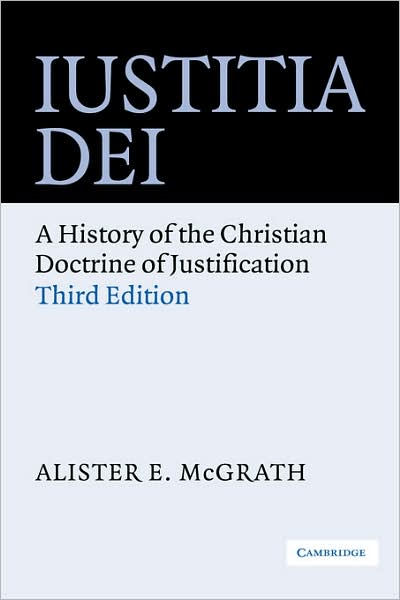
The hardback is $80.00 while the sofback is $35.00
I don't have the book yet, but it looks like a pretty good read. I can't really buy any new books until I relocate anyway, but this is most definately something I'm gonna get as soon as I'm done moving.
From what I saw from the reviews(As well as the author...in whom I like by the way), it seems to be from a mostly western protestant bias, and I reject what one of the reviews said about the greek fathers picking up the idea of "free will" from paganism. The truth is, the greek philosophers were all over the map. Some were determinists of different stripes, while others believed in free will. But to say that they got the idea from them is pure nonsense.....for both the greek and pre-Augustinian(including Augustin in his early christian years) latin fathers, nonfathers, as well as "some" heretics all believed in free will. It just wasn't the greek fathers, and it just wasn't the converts(Clement of Alexandria and Saint Justin Martyr,.....Origen was a cradle) that had a background in philosophy either. Free will was also advocated by all the pre-nicene christians that hated greek philosophy. And so, they didn't pick it up from them. Those who did have a philosophy background simply used what they saw was useful and compatible with what Christianity was already teaching.
I may not agree with everything I saw in the reviews, but I did agree with enough to want to buy it, and so, it is on my things to get list.
ICXC NIKA
The Divine Mysteries: differences between east and west
Mystery and Sacramentality: East and West:
Play Audio
ICXC NIKA
Every Zebra is a horse, but not every horse is a Zebra

MG, over at Energetic Procession tackles the issue of early church government:
http://energeticprocession.wordpress.com/2009/11/20/apostolic-succession-1-presbyter-bishop/
The Roman Catholic Mark Bonocore looks at the issue as well:
http://www.bringyou.to/apologetics/a80.htm
Everyone may not agree with me, but when I looked at the issue, I saw:
1.) Every Bishop was an Elder, but not every elder was a Bishop (because the Apostles were also bishops)
KJV
Acts chapter 1:16-26
"Men and brethren, this scripture must needs have been fulfilled, which the Holy Ghost by the mouth of David spake before concerning Judas, which was guide to them that took Jesus.
For he was numbered with us, and had obtained part of this ministry.
Now this man purchased a field with the reward of iniquity; and falling headlong, he burst asunder in the midst, and all his bowels gushed out.
And it was known unto all the dwellers at Jerusalem; insomuch as that field is called in their proper tongue, Aceldama, that is to say, The field of blood.
For it is written in the book of Psalms, Let his habitation be desolate, and let no man dwell therein: and his bishoprick let another take.
Wherefore of these men which have companied with us all the time that the Lord Jesus went in and out among us,
Beginning from the baptism of John, unto that same day that he was taken up from us, must one be ordained to be a witness with us of his resurrection.
And they appointed two, Joseph called Barsabas, who was surnamed Justus, and Matthias. And they prayed, and said, Thou, Lord, which knowest the hearts of all men, shew whether of these two thou hast chosen,
That he may take part of this ministry and apostleship, from which Judas by transgression fell, that he might go to his own place.
And they gave forth their lots; and the lot fell upon Matthias; and he was numbered with the eleven apostles."
2.) The Apostles were Elders but not every Elder was an Apostle
NKJV
1st Peter 5:1-4
"The elders who are among you I exhort, I who am a fellow elder and a witness of the sufferings of Christ, and also a partaker of the glory that will be revealed: Shepherd the flock of God which is among you, serving as overseers, not by compulsion but willingly, not for dishonest gain but eagerly; nor as being lords over those entrusted to you, but being examples to the flock; and when the Chief Shepherd appears, you will receive the crown of glory that does not fade away."
and
NKJV
2nd John 1:1
"The Elder, To the elect lady and her children, whom I love in truth, and not only I, but also all those who have known the truth,"
3.) A difference among elders is not only seen with the Apostles and the other elders, but also with Timothy, and Titus and the other elders as well.
Timothy 1:5:17-22
"Let the elders who rule well be counted worthy of double honor, especially those who labor in the word and doctrine. For the Scripture says, “You shall not muzzle an ox while it treads out the grain,” and, “The laborer is worthy of his wages.” Do not receive an accusation against an elder except from two or three witnesses. Those who are sinning rebuke in the presence of all, that the rest also may fear. I charge you before God and the Lord Jesus Christ and the elect angels that you observe these things without prejudice, doing nothing with partiality. Do not lay hands on anyone hastily, nor share in other people’s sins; keep yourself pure."
and
Titus 1:5-6
"For this reason I left you in Crete, that you should set in order the things that are lacking, and appoint elders in every city as I commanded you— if a man is blameless, the husband of one wife, having faithful children not accused of dissipation or insubordination."
I personally don't see a difference between Titus, and Timothy, and what would later be called "Monarchical bishops". ........for even the Apostles acted like Monarchical Bishops.
ICXC NIKA
Holy Scripture Volume IV? What Webster and King Don't Tell You
http://www.bringyou.to/apologetics/ATHAN.htm (St. Athanasius
on Scripture, Tradition, and Catholic Doctrine in reply to William Webster and David King)
and
http://www.bringyou.to/apologetics/num50.htm (St. Athanasius vs. William Webster: A Debate From Greg Krehbiel's EZBoard)
ICXC NIKA
Related links:
Saint Athanasius and the "scope of Faith"
Pope makes it easier for TAC Anglicans
And so the race is on........who will get the most Anglicans?
The link:
http://news.yahoo.com/s/nm/20091020/...ican_anglicans
Quote:
Quote:
"VATICAN CITY (Reuters) – Pope Benedict on Tuesday took a major step to make it easier for disaffected Anglicans who feel their Church has become too liberal to convert to Roman Catholicism.
The move comes after years of discontent in some sectors of the 77-million-strong worldwide Anglican community over the ordination of women priests and homosexual bishops.
While both sides stressed the step would not affect dialogue between the two Churches, it was clear it was taken because of the growing number of Anglicans who want to leave their Church.
The Vatican said the Pope had approved a document known as an "Apostolic Constitution" to accept Anglicans who want to join Catholicism, either individually or in groups, while maintaining some of their own traditions.
It marks perhaps the clearest and boldest institutional step by the Vatican to welcome disaffected Anglicans into the fold since King Henry VIII broke with Rome and set himself up at the head of the new Church of England in 1534.
The new structure allows for the appointment of leaders, usually bishops who will come from the ranks of unmarried former Anglican priests, to oversee communities of former Anglicans who become Catholics and recognize the pope as their leader.
"In this way, the Apostolic Constitution seeks to balance on the one hand the concern to preserve the worthy Anglican liturgical and spiritual patrimony and, on the other hand, the concern that these groups and their clergy will be integrated into the Catholic Church," the Vatican said.
MANY REQUESTS
It said the decision was taken to respond "to the many requests that have been submitted to the Holy See from groups of Anglican clergy and faithful in different parts of the world who wish to enter into full visible communion."
The most prominent recent Anglican convert to Catholicism was former British prime minister Tony Blair, who joined after leaving office in 2007.
The new regulations, due to come into effect soon, will not affect the Catholic Church's ban on its own priests marrying. But they will continue the age-old practice of allowing a married Anglican priest who converts to remain married.
Anglicans will find it easier than before to join the Catholic Church because they will be able to use a standard benchmark of rules and obligations for conversion.
Men who want to become priests and come from an Anglican background will study together with Catholic seminarians even if they are destined to eventually administer to former Anglicans.
Archbishop of Canterbury Rowan Williams, spiritual leader of the worldwide Anglican communion, told a news conference in London that he did not see the Vatican move as "an act of aggression" or vote of no confidence, but part of a routine relationship between the two Churches.
Both Vatican and Anglican officials stressed that both churches would continue dialogue aimed at eventual reunion.
"This is not a comment on the life of the Anglican Communion. This is a response to people who came forward," said Vincent Nichols, the Archbishop of Westminster and head of the Catholic Church in England and Wales.
Vatican and Anglican officials were coy when asked about the number of potential converts."
To read the rest, please goto the link.
This is what NPR had to say about it:
Audio
ICXC NIKA
Semi - Atheism & the eventual slide into modern secularism / Atheism
Cessationism is only one of the factors I saw which led to my speculation of modern Atheism coming from particular former christian circles. When you add Cessationism with alot of other things, then you can see how Atheism and Secularism in general eventually took over the western World.
There were alot of events one can look at in time that helped secularism become what it is now. Charlse Darwin's book.......the origin of species.....being one of them, for most christians around that time were Old Earth Creationists......including a number of Darwin's college professors. After he wrote that book however, you start to see a number of Old Earthers switch to Theistic Evolution, while a number of others lost faith and became either Agnostic or Atheistic evolutionists. YEC (Young Earth Creationism) came back in style around the 1960's, but that book(the origin of species) single handedly took science out of the hands of christianity, and completely into the hands of secularism. And so that played a role as well. And so you gotta add alot of things together in order to see a fuller picture.
http://ancientchristiandefender.blog...m-atheism.html/
Quote:
Quote:
"It is my view that Calvinism is semi-Atheistic. Especially those Calvinists that are "cessationists" I point the finger at the Zwingli/Calvin Compromise. This compromise was one of the reasons why the Reformed churches couldn't unite with the Lutherian churches.
But I would like to quote a few things by Alister Mcgrath to show that I wasn't wrong for speculating this.
He says on page 146 of his book "Christianity's Dangerous idea: The protestant revolution-a history from the sixteenth century to the twenty-first":
"The appeal of the Enlightenment proved greatest within Reformed circles. For
reasons that remain unclear, rationalism gained acceptance in many former
Calvinist strongholds. Geneva and Edinburgh, both international centers of
Calvinism in the late sixteenth century, were noted as epicenters of European
rationalism in the late eighteenth century. John Calvin and John Knox gave way
to the very different worldviews of Jean-Jacques Rousseau and David Hume. In
marked contrast, the Enlightenment had relatively little impact on Catholicism
during the eighteenth century-unless, of course, the French Revolution (1789) is
seen as a political extension of the ideas of the Enlightenment."[1]
He mentions this again in passing on page 264 while talking about the stripping away of the "sacred/supernatural" and the rise of the Atheistic worldview.
"While most Elizabethan Protestants were happy to follow continental ideas,
especially those of Calvin, their Jacobean and Stuart successors were
increasingly aware of the need to symbolize the interaction and interpenetration
of the sacred and secular. The poetry of George Herbert can be seen as an
attempt to retain an essentially Calvinist theology of the Sacraments, while
developing its capacity to promote the Church's social and confessional
cohesion.
This decoupling of the sacred from the quotidian, characteristic
of certain types of Protestantism, accelerated the rise of a functionally
atheist worldview in which God was not regarded as an active participant in the
worldview. It is no accident that two sixteenth-century European centers of
Calvinism-Geneva and Edinburgh-had became centers of rationalism two centuries
later.
We shall have more to say about this development later. Yet it is
important to appreciate here that one of the most fundamental characteristics of
Pentecostalism is its insistence that the divine may be encountered in the
secular realm. Its astonishing success points to the reversal of this trend and
the emergence of a new form of Protestantism characterized by its expectation of
the direct experience of the spiritual within the mundane."[2]
I am not the onlyone who sees a connection between Calvinistic theology with the rise of Atheism. I'm not gonna say all, but alot of Calvinists tend to disregard any idea of "mystery" for the sake of "rationalism"/logic.
Also, if you watch the 3rd video in the BBC documentary of how modern Secularism owes alot to the Reformed sector of the
Protestant Reformation, then you will see what I mean by "semi-Atheism"
A Reformation of the Mind
The eventual slide into Atheism / modern secularism is also seen by this book, which charts some of the changes of ideas and methods which also caused a change of worldviews.
The Bible, Protestantism, and the Rise of Natural Science
Quote:
Quote:
"Product Description
Peter Harrison examines the role played by the Bible in the emergence of natural science. He shows how both the contents of the Bible, and more particularly the way it was interpreted, had a profound influence on conceptions of nature from the third century to the seventeenth. The rise of modern science is linked to the Protestant approach to texts, an approach that spelled an end to the symbolic world of the Middle Ages, and established the conditions for the scientific investigation and technological exploitation of nature.
Also, when you look at the early apologetical wars about Scripture, error, ......etc. between Protestants....mainly puritans, and Roman Catholics, then you will also see that a century or so later, Liberal Protestants started to use those very same tools, and methods more consistantly in attacking the very scriptures that Protestants believe in.
Quote:
Quote:
"quote:
"Appeals to supposed errors in the Deuterocanon have long peppered
Protestant/Catholic debates and rendered it far uglier than it needed to be.
Because Catholicism was its target, few had the forethought that this method
could be used against the rest of the Bible. As the Reformed scholar Edward
Ruess noted, "The scoffs thrown at the little fish of Tobit will sooner or later
destroy Jonah's wale." Ruess prophetic words have been fulfilled by the
extravagances of higher criticism.
After the Apocrypha controversy had subsided,
critics turned the same weapons against, not only the Prophet Jonah, but also
the rest of the books of scripture. So-called errors and absurdities were
quickly expunged from the Protocanon of the Old and New Testaments. Whole books
were labeled (or libeled) as myths and fables. The end result is a bible where
only a few passages are worthy of belief. Anti-Catholic polemicists have
unwittingly opened a Pandora's box.
They assumed no one would ever dare charge
the rest of scripture with errors and absurdities, yet the advent of liberal
Protestantism brought with it individuals who did not fear to apply these
arguments consistently throughout the entire Bible. The problem at the heart of
this line of argumentation is one of pride. It places the intellect in the role
of judge, allowing it to sit in judgement upon the word of God. [3]"
In the Roman Catholic world, we can see Atheism forming in France from Jansenism. Jansenism is very similar to Calvinism in many ways, and I find it interesting that some would link French Atheism with the Jansenism, as seen here:
Quote:
"Since Jansenism had originated in Holland, the Dutch bishops were suspect; and in 1670 the Archbishop of Utrecht was summoned to Rome to answer a charge of heresy. He returned uncondemned, but in 1710 the Archbishop-elect, selected by the chapter, was excommunicated for protesting against a summons to appear before a papal nuncio at Colegne, After thirteen years' limbo, however, on 15 October 1724, Cornelius Steenoven was consecrated Archbishop, in due line of Apostolic succession, by Bishop of Babylon, whereupon the Old Catholic Church of Holland began a separate existence, one which still continues. Jansenism also survived in France but almost entirely politically and without its original idealism. The conflict it caused has, in fact, led to the accusation that it formented the spirit of atheism and the anti-religion which helped to bring about the French Revolution.. [4]"
Both Calvinism and Jansenism are hardcore forms or mutations of ruff deterministic Augustinianism, and so Augustinianism can be seen as playing a role in all this.
A good movie to watch for Atheists, as well as for semi-Atheists would be the The Exorcism Of Emily Rose
This movie was based on a true story, and it shows the conflict between modern secularism/Atheism/Naturalism and the spiritual world.
ICXC NIKA
[1], and [2] by Dr. Alister Mcgrath, from the book Christianity's Dangerous idea: The Protestant Revolution-A history from the sixteenth Century to the twenty-First. Published by HarperOne. Copyright 2007
[3] pages 322 & 323 from the book "Why Catholic Bibles are Bigger: The
untold story of the lost books of the Protestant Bible" by Gary G. Michuta
(copyright) 2007
[4] pages 171-174 from the book "A history of Heresy" by David Christie-Murray
A Roman Catholic debunking a jack chick tract
Part 1 of 17:
Part 2 of 17:
Part 3 of 17
Part 4 of 17
Part 5 of 17
Part 6 of 17
ICXC NIKA
What still divides Protestantism and Roman Catholicism?
Michael Horton, W. Robert Godfrey & Rod Rosenbladt (Protestant)
vs.
Patrick Madrid, Robert Sungenis & William Marshner (Roman Catholic)
The Roman Catholic Link:
http://www.surprisedbytruth.com/shop/shopexd.asp?id=120
The Reformed Protestant Link:
http://www.whitehorseinn.org/specialoffers/welcome.htm
An article by an Orthodox Christian who witnessed the debate:
http://www.touchstonemag.com/archive...id=08-04-044-r
ICXC NIKA
 Labels:
Arminianism,
Calvinism,
debates,
Protestantism,
Roman Catholicism,
semi-pelagianism
|
Labels:
Arminianism,
Calvinism,
debates,
Protestantism,
Roman Catholicism,
semi-pelagianism
|
 0
comments
0
comments
Why Natural Science rose in the western world.
Dr. Peter Harrison did research in this area and wrote about it in the book "The Bible, Protestantism, and the Rise of Natural Science". From what I've seen in reviews of his latest book (The fall of man and the foundations of natural science), he goes into more detail about this very thing.
pages 56-63
" Restoring Lost Likeness
If the book of nature was to be read in conjunction with the book of scripture, it was no less true that the message to be read in the natural world was similar to that of scripture: nature provided knowledge of God and pointed the way to redemption. The possibility that God might be known through resemblances in the world was already familiar to readers of those Platonic works which had proved so influential in the twelfth century, all of which had stressed the world is 'a sensible God who is the image of the intellectual'. The Asclepius repeats this claim describing the cosmos as a god 'who can be seen and sensed'. Macrobius further extended this conception, describing the visible world as the temple of God:
In order to show, therefore, that the omnipotence of the Supreme God can hardly ever be comprehended and never witnessed, he called whatever is visible to our eyes the temple of that God who is apprehended only in the mind, so that those who worship these visible objects as temples might still owe the greatest reverence to the creator, and that whoever is inducted into the privileges of this temple might know that he had to live in the manner of a priest.
Twelfth-century writers, while wary of the dangers of pantheism, were nonetheless influenced by these conceptions and came to stress in an unprecedented way the possibility of knowing God through his creatures. Hildegard, for example, tirelessly reminds us that "all Creatures are an indication of God'm that 'it is God whom human beings know in every creature'. Whereever we look', agreed Grosseteste, 'we find vestiges of God.' Hugh of St Victor was similarly enthusiastic about the prospects of a knowledge of God through nature: 'Every nature tells of God; every nature teaches man; every nature reproduces its essential form, and nothing in the universe is infecund.' Indeed, of all twelfth century writers, it was Hugh of St Victor who most explicitly set out the connexion between the reading of the two books.
Hugh's Didascalicon, subtitled De studio legendi (On the study of reading), was the twelfth-century equivalent of Augustine's De doctrina christiana. In it Hugh advances familiar platonic arguments: on the hand, because the 'invisible things can only be known by visible things', the whole of theology must use visible demonstrations; on the other, 'worldly theology' never progressed beyond the appearances of things, was always marred by the 'stain of error'. Hugh like th emajority of his contemporaries, also endorsed Augustine's view that in scripture 'things as well as words are significant.' Hugh's advance on Augustine comes in his conclusion that the study of things must therefore be a significant source of truth in its own right. As it turned out, the curriculum of the medieval schools neatly matched this distinction between the study of words and things. The seven liberal arts were taught in order to serve the higher purpose of uncovering the meanings of the sacred page: the Trivium (grammar, rhetoric, and dialectic) illuminated the meanings of words; the Quadrivium (music arithmetic) illuminated the meanings of words; the quadrivium (music, arithmetic, geometry, astronomy), the meanings of the things referred to by the words. Again, the reading of things was controlled by the now standard categories of tropology and allegory: tropological interpretation of things led to virtue, allegorical interpretation led to truth. These two things, virtue and truth, together restore the divine likeness: 'Now there are two things which restore the divine likeness in man, namely the contemplation of truth and the practice of virtue. The contemplation of truth required knowledge of things of nature, and such knowledge was a means of restoring a lost divine likeness.
To know the world, then, is not merely to come to know God, it is to become like God: it is to restore a likeness which had been lost. For all
that medieval thinkers were to place the human race at the very centre of the cosmos, theirs was no shallow optimism. They had read beyond the Idyll in Eden, to the fall, the first homicide, and the sordid events which brought on the Deluge. Whatever pride might have resulted from the vision of man as a microcosm of the universe was thus muted by the sober recognition that human beings were fallen creatures, and that when the crown of creation had fallen, his dominions had fallen with him. The lustre of the luminous signs of divinity which had once shone out in the material world had now dimmed through that first human misadventure. Those similitudes which originally had borne witness to the spiritual origins of the world were now reduced to what Augustine and Grosseteste both termed 'vestiges'. Other created things, too, lost their obvious similitude to those divine ideas which had been their original cause. Indeed, for those scholled in Platonism, the whole physical world become a place of dissimilitude, for as Plato had observed in The Statesman, when creatures fall away from God, they enter 'the bottomless abyss of unlikeness.' Plotinus had reiterated this sentiment, describing the fate of human souls in these terms: 'We are become dwellers in the Place of unlikeness, where, fallen from all our resemblance to the Divine, we lie in gloom and mud.' The idea that this fallen creation was a 'region of dissimilitude' (regio dissimilitudis) was adopted by Augustine, and like so many of his borrowing from Platonism, found its way into medieval thought. Yet, whereas for Augustine the solution to our plight lay in retreat from this earthly region of dissimilitude to the more ordered world of the mind, for those progressive spirits of the twelfth century the lost similitudes of things could be re-established, and while such an ordering process was ultimately still to take place in the mind, it began with a knowledge of the sensory world. Empirical nature was to be re-ordered by human knowledge, and thus the human conception of the world, of 'nature', would be that same conception which had been in the mind of the Creature. In this manner the human mind would come to resemble the mind of God, and the human likeness to god would by this means be restored. Human beings stood in need of redemtion, and indeed it is this necessity for their redemption, and the redemtion of the world, which transformed what in antiquity had tended to be a static and sterile representation of their relation to the whole, into a dynamic programme. god's creatures must now embark upon that path which would result in the restoration of their former dignity, and that path would lead them to the attempt to know and master the world. Through knowledge, the world would be reunited, and both knower and known would be redeemed. The human being was to 'comprehend' all things in both ontological and epistemological senses of that term. The turn to the natural world was in some sense a turning away from the sacred page, but it could hardly be said that it was motivated by a secular, or non-theological impulse. On the contrary, acquisition of knowledge of the order of nature was enjoined on mankind as an integral part of the procees of human redemption, and more specifically, a reversal of the losses incurred at the Fall.
In the emerging recognition that the goal of human life was to do with knowledge, mastery, and the regaining of an original perfection through a re-ordering of similitudes, there are again unmistakeable achoes of Plato. In the closing lines of the Timaeus Plato informs us that 'learning the harmonies and revolutions of the universe, should coorect the courses of the head which were corrupted at our birth, and should assimilate the thinking being to the thought, renewing his original nature, so that having assimilated them he may attain to that best life which the gods have set before mankind. Knowledge of the harmonies and revolutions of the universe thus leads to a renewal of corrupted human nature. The study of nature was thus an essentially religious process. Similar themes can be found in the Hermetic writings: 'learning the arts and sciences and using them preserves this earthly part of the world: god willed it that the world would be incomplete with out them. In a more elaborate passage, the reader is given this counsel:
so you must think of god in this way, as having everything- the cosmos, himself, the universe-like thoughts within himself. Thus, unless you make yourself equal to god, you cannot understand god; like is understood by like.....Having conceived that nothing is impossible to you, consider yourself immortal and able to understand everything, all art, all learning, the temper of every living thing. Go higher than every height and lower than every depth. Collect in yourself all the sensations of what has been made, of fire and water, dry and wet; be everywhere at once, on land, in the sea, in heaven; be not yet born, be in the womb be young, old, beyond, death. And when you have understood all these at once- times, places, things, qualities, quantities- then you can understand god."
The human, according to the Corpus Hermeticum, was created 'to be a working witness to nature; to increase the number of mankind; to master all things under heaven.......and to discover every means of working skillfully with things that are good.'
This analysis of the human quest as one involving the restoration of original similitudes is also a New Testament theme. St Paul wrote: 'And because for us there is no veil over the face, we all reflect as in a mirror the splendour of the Lord; thus we are transformed into his likeness.' Elsewhere, he was to speak of Christian life as being a new life 'which is being constantly renewed in the image of its creator.' The means by which twelfth-century thinkers proposed this redemption take place however, was quite new, for the process of the restoration of the divine similitude in man required the similitude between all created things to be restored. This was to take place in two ways: first, by knowing the world, the human mind would restore things to the original unity which they had possessed in the divine mind; second, by controlling and subduing the world, human beings would be restored to their original position as God's viceroy on earth, and harmony would be restored between those creatures wiyhin their constituency. The restoration of a lost likeness to God was thus to take place through imitation of God: of his power, by manipulating the world; of his wisdom, through coming to know it. To know God, to become like God, to possess the knowledge of the mind of God, these were synonyms for the process of redemption Redemption, in short, did not entail as it did for Augstine, flight from the material world, a mastery of the beasts within, and a mystical absorption into divine reality, but rather an ordered knowledge of the natural world.
The restoration to the human race of a lost similitude to God was thus seen to entail a restoration to creatures of their proper relations-relations which were to be established on the basis f similitude. For the human mind again to be godlike, it had to recapture the vision of nature as an ordered whole. The accumulation and systematisation of information about animals and plants was an ordering process, a rehearsal of that event in Eden, in which God had paraded the animals before Adam to be named- and event which, according to a long exegetical tradition, indicated Adam's perfect knowledge of the natural world. This knowledge had been lost as a result of the human Fall. Adam had penetrated to the true nature of things with the eye of reason, we now are forced back on sensory experience and grope our way' towards knowledge. 'Through [the organs of sense' man looks upon all the creatures', wrote Hildegard, 'knowing them for what they are, distinguishing them, separating them, naming them'. The Fall was the occasion of the loss of direct access to the spiritual world. Thereafter, knowledge of spiritual truths was mediated through material things.
This idea-that the accumulation of knowledge about the natural world would in some measure restore to man what had been lost at the Fall-is most commonly associated with Francis Bacon and the rise of modern science. Yet we can now see that the roots of this conception go back much further. The imperative element which is incipient in the vision of man as the unique locus of two images becomes increasingly obvious in the writings of the twelfth century. Hugh of St Victor(1142) suggested that the chief depredation suffered by man at the fall was a loss of knowledge. Through study, the soul could rediscover the divine truths hidden behind the veil of the creatures and theliteral words of scripture, and thereby be restored to its original dignity. In his Didascalicon Hugh explains that the aim of study is 'to restore within us the divine likeness' so that 'we are conformed to the divine nature' and 'there begins to shine forth again in us what has forever existed in the divine Idea or Pattern, coming and going in us but standing changeless in God. Similar ideas are expressed by Honorius Augustodunensis. Despite the Fall and the ills it brought upon the world, terrestrial reality remains the sphere of 'multiple divine appearances'. Man is the celestrial animal in which God willed all things to be re-united. the idea that man was a microcosm was thus at once indicative and imperative. All creatures were in a sense to be found in man, and in another were to be re-united in him through an orderly knowledge of the natural world. In the thirteenth century, Bonaventure again stressed the role which the visible world was to play in the redemption of mankind. Man, 'in the state of innocence possessed knowledge of created things and was raised through their representation to God and to his praise, reverence, and love'. While this knowledge was lost through the misadventures of our first parents, its re-acquisition is still 'the goal of the creatures and the way in which they are led back to God'. To accumulate systematic knowledge of created things was both to restore the knowledge of Adam, and approach knowledge of the very mind of God. Through the acquisition of knowledge came also the redemption of the world, for knowledge was assimilated or incorporated in the human mind, and thus redeemed along with it." The twelfth and thirteenth centuries witness the end of the religious indifference, or even hostility, to the physical world which had been fostered by the Fathers. Augustine had believed that a person might be deficient in knowledge of nature, and yet have a robust faith. There is no shame in being 'ignorant of the position and nature of a physical creature', he wrote, provided that one 'does not believe something unworthy of you, Lord'. Now the pendulum was beginning to swing back, and an ordered knowledge of this world could not be so easily divorced from the knowledge of the other. Adelard of Barth observed that 'if anyone born or educated in the residence of this world neglects learning the plan underlying its marvellous beauty, upon attaining the age of discretion he is unworthy and, were it possible, deserves to be cast our of it.' William of Conches likewise expressed contempt for those who would perpetuate the Augustinian indifference to science: 'Ignorant themselves of the forces of nature and wanting to have company in their ignorance, they don't want people to look into anything; they want us to believe like peasants and not ask the reason behind things.' With those who habitually invoked the direct activity of God in physical explanations he was equally impatient: 'You poor fools, God can make a cow out of a tree, but has he ever done so? Therefore show some reason why a thing is so. or cease to hold that it is so.' This period thus witnessess the beginnings of the transformation of the study of nature into a thoroughly theological enterprise. Thereafter, in the schools natural philosophy was increasingly intergrated into the Christian scholarly endeavour. In the renaissance of the twelfth century we see a religiously-motivated indifference to the natural world transformed into a religiously-motivated quest for knowledge. Alongside the words inscribed by God upon the human heart and on the sacred page of scripture, stands the book of nature. The search for truth reguired the diligent study of both books." [1]
Later, the rise of Protestantism and their rejection of multiple interpretations of the text of scripture would soon cause for the rejection of the symbolism of nature. So just as scripture would only have "one" meaning, "nature" too would only have "one" interpretation, and that would be "philosophical naturalism". Some centuries after the protestant reformation, this "hermenutic" would backfire, and would cause not only the rise of protestant liberalism and the rejection of the supernatural in scripture, but also the secularization and independance of the natural sciences from western christianity.
As seen from the preface of the book:
"In this book Dr Harrison examines the role played by the Bible in the emergence of natural science. He shows how both the contents of the Bible, and more particularly the way it was interpreted, had a profound influence on conceptions of nature from the third century to the seventeenth. The rise of the modern science is linked to the Protestant approach to texts, an approach which spelt an end to the symbolic world of the middle ages and established the conditions for the scientific investigation and technological exploitation of nature." [2]
JNORM888
[1] pages 56-63, [2] preface, from the book “The Bible Protestantism and the rise of natural science” by Dr. Peter Harrison
Blogs: Eastern Orthodox
-
-
Why Not Use Ancient Rites?6 years ago
-
-
When Everyone Is Watching4 months ago
-
-
-
It’s Time to Say Goodbye4 years ago
-
About the Mystagogy Resource Center4 months ago
-
-
Orthodox Life15 years ago
-
-
Resurrection Sunday 20266 months ago
-
-
The End of This Work10 months ago
-
-
The end of Pious Fabrications12 years ago
-
-
Bending Toward Bethlehem2 years ago


Blogs: Oriental Orthodox
-
-
Restoration of The Son10 years ago


Blogs: Roman Catholic
-
-
-
-
-
-
A Brief Update12 years ago
-
-
-
My Sister's New Blog15 years ago
-


Blogs: Anglo-Catholic/ACNA
-
SYNAGO3 days ago
-
Hello world!2 years ago
-
-
-


Blogs: Lutheran Protestant


Blogs: Mostly Arminian Protestant
-
Book Review: Grace for All11 years ago
-
-
Denah Rumah Type 36 Luas Tanah 728 years ago
-
Christian Rappers and Collaborations15 years ago
-
-
-
-
-
-
-
-
-
-
NOT Independence Sunday17 years ago
-


Blogs: Reformed Protestant
-
-
Do Not Disavow2 years ago
-
-
This Blog Has Moved!!!12 years ago
-
-
Is Peter the Rock of the Church?16 years ago
-
-


