Saint Moses the Black

Saint Moses the Black

Popular Posts
-
This is Sho Baraka (an old college friend from Tuskegee University and calvinist christian rapper) and this is off his new album (Lions ...
-
As seen by the dailymail.co.uk : Quote: "The Church of England could be virtually extinct in 20 years as elderly members die, an An...
-
Learn Greek: Lesson 1 Learn Greek: Lesson 2 Learn Greek: Lesson 3 Learn Greek: Lesson 4 Learn Greek: Lesson 5 Learn Greek: Lesson 6 (The num...
-
This youtube video was done by Kingneb. The fullpreterist Prespyterian I argue with alot. The website at the end is KingNeb's website. I...
-
This is where it came from. " from this forum " and it was mostly adressed to other protestants, mostly calvinistic protestants th...
-
Is an up and coming christian rap artist from Great Britain. Below is a Youtube of one of his videos Dwayne Tryumf on a British news station...


Saint John the Theologian

Saint John the Theologian
Facebook Badge

Subscribe


 Posts
All Comments
Posts
All Comments

private judgment
 3:51 PM |
  Posted by
Jnorm |
Posted by
Jnorm |


R. N. said:
"Context, Jnorm.... context, context, context. No sentence nor paragraph is an island. Foremost rule of hermenuetics and all, but maybe that is foreign to your group, I dunno."
I quoted what I did for a reason. You were denying private judgement in regards to Sola Scriptura. As if it had nothing to do with the issue. It obviously has something to do with it.
Also if you read the first page of this thread then you would know that I am aware of what Keith A. Mathison calls Sola Scriptura vs Solo Scriptura. And yes, I will stick by what I said in regards to how I think Sola can easily slide into Solo.
Why?
The issue of private judgment. All the ancient stuff that I hold too.....including the creeds.......will only be accepted by you if you think they are Scriptural. We all know that you are free to pick and choose what pieces of the ancient creeds you like. Do you believe in Baptismal Regeneration? Probably not......and yet you may think you hold to Constantinople 1. Do you believe the Father to be Monarch? Probably not.......and yet you might think you hold to the First council (Nicaea).
Now Why do I say this?
Because you might have the common excuse or cop out of saying "well I don't think this part of the creed is Scriptural, and so I'm not going to accept it".
A full Preterist protestant can say the samething about the part of the creed in regards to the 2nd Advent. They can use the same cop out. The same excuse......the same argument. Not only that, but a number of other protestants can as well. It just all depends on the issue they personally disagree with. Yeah, you all will talk as if you believe some of the ancient creeds, and ancient faith, but when the push comes to shove, you will pick and choose based on what you think is biblical or not. There are some Reformed who are serious about some of the ancient creeds.....like Federal Vision, NPP, Auburn Ave and company, and some of the more high Lutherans, and Anglicans. But a number of Reformed and Calvinistic Baptists don't like these folks and what they are about. And so what does this tell you in the area about embracing the ancient creeds, and ancient faith as subordinate authorities? It should tell you that it's a bunch of lip service! Yeah, there is a distinction between Sola and Solo, but when push comes to shove, Sola can fold into Solo.
This is why I focused on the quote that I did from Charles Hodge.
Why?
Because ultimately it will come down to that issue. And you know it!
R. N. quoted:
Hodge (the paragraphs immediately prior to your quote):
"It is not denied that the Scriptures contain many things hard to be understood; that they require diligent study; that all men need the guidance of the Holy Spirit in order to right knowledge and true faith. But it is maintained that in all things necessary to salvation they are sufficiently plain to be understood even by the unlearned."
What does this have to do with what I quoted from Charles Hodge? I already mentioned the idea of essential doctrines (even if you nor any protestant can 100%ly agree on what the essentials are) in regards to the issue of Sola Scripura in this thread.
You also quoted this from Hodge:
"It is not denied that the people, learned and unlearned, in order to the proper understanding of the Scriptures, should not only compare Scripture with Scripture, and avail themselves of all the means in their power to aid them in their search after the truth, but they should also pay the greatest deference to the faith of the Church. If the Scriptures be a plain book, and the Spirit performs the functions of a teacher to all the children of God, it follows inevitably that they must agree in all essential matters in their interpretation of the Bible. And from that fact it follows that for an individual Christian to dissent from the faith of the universal Church (i. e., the body of true believers), is tantamount to dissenting from the Scriptures themselves."
John Calvin felt free to deny the Eternal Generation of the Son. Now I could be wrong, but I think Charles Hodge agreed with him. I don't know about you, but I would call the doctrine of the Trinity an essential. I would also call the first two councils ecumenical....or universal. And not only that, Charles Hodge fought against John Williamson Nevin (Mercersburgh Theology).
I could be wrong, but I think the Mercersburgh group was serious in regards to the area of what you quoted from Hodge. Not only that, but I think they were headed in the right direction. And so what does Hodge really mean? He obviously didn't mean what the Mercersburgh group meant! He obviously didn't mean what I believe and hold too! And so the part I quoted from Hodge was appropriate.
For at the end of the day, the right of private judgment is what it will really come down to. If you are fighting against the ancient Faith, it is because of Private judgment/conscience of what you think is biblical.....etc.
R. N. said: "Call me crazy, Jnorm, but I don't think Hodge meant what you think he meant. Private interpretation, as you have been touting it, is that anyone can come to any conclusion that anyone deems valid when reading Scripture and that that interpretation is just as valid as the next (which, I believe, is why you erroneously conflate anti-trinitarian cults with protestantism). Except, the thing is, even this authority that you claim to use in understanding Sola Scriptura rejects that very notion (see the last three sentences I underlined)."
I will stick by what I said. Is Baptismal Regeneration an essential issue? I can go on and on and on! At the end of the day, your subjective veto power to disagree with the ancient creeds and Faith is what it will come down to. When everyone has that veto power then you will wind up with thousands of different competing groups.
R. N. said: "Because it appears too hard to grasp, I'll explain Hodge's explanation is simple terms:
On matters necessary to come to, and maintain, the true, catholic faith - Scripture is plain."
This is subjective. And if you can't see the subjectivity in this, then I'm sorry, but I can't help you. Yes, I do understand what Charles Hodge said. I just know that protestants can't 100%ly agree on matters necessary to come to, and maintain, the true catholic faith. Now why would I quote that part if I know protestants don't 100%ly agree on what is and isn't essential? Thus, what I quoted from Hodge was appropriate.
R. N. said: "All men are encouraged, and required, to read the Scriptures. In their study they should come to the same conclusion, that is the true faith. If they do not, they are dissenting against the Scriptures. On the tougher things, Scripture remains the final authority, and all men should study the Scripture. In their study they should compare Scripture to Scripture as well as pay deference to the faith of the church."
Most of what you said up above is subjective. I mean, why aren't you a Lutheran? Why aren't all protestants Lutherans? Yet, you are upset that I quoted something that really mattered. The reason why you aren't Lutheran is because you have the right(private judgment) not to be, based on how you understand Scripture.
That's it in a nutshell! And so, once again. At the end of the day, it will come down to the issue of private judgment.
R. N. said: "What we deny, as Hodge points out in the out of context section that you quote, is that any man or men hold authority over us higher than Scripture. Scripture binds us, not the judgment of men."
It wasn't out of context. The issue of private judgment is linked to the issue of Sola Scripture.
R. N. said: "Not our own judgement (where's Daniel's head to wall gif?), for there is the possibility of error, but Scipture (our own discretion is dependent on the work of the Holy Spirit - as Hodge also points out but you've appeared to miss). And then Hodge goes on to explain why - by providing Scriptural reference, no less."
I didn't miss it. I am a former Baptist protestant, and so I know about the individual being guided by the Holy Spirit in understanding God's word. I didn't include that because the Holy Spirit isn't the author of confusion. You don't blame the Holy Spirit for the mess we have today.
No, what you blame is the part I quoted and highlighted from Hodge. That is what you blame. For that is the problem. Now in saying this I do recognize that other protestants will state the issue of private judgment differently, but not all protestants do that.
Also, even when they do state the issue differently, it's not like I believe them. For they are not being honest about the issue. They are just trying to hide the fact that they are the ones that have the last say. Thus, they are using Scripture as a smoke screen.....something to hide behind.
 Labels:

Questions
C.B. said:
"Jnorm, I find your arguments pretty persuasive (my best friend in a Baptist turned EO too)."
Did he turn EO in a Baptist seminary? I know a number of new converts that did while in seminary or while pastoring.
C.B. said:
"But...do you hold that its impossible for error to be introduced in the church's practice and theology?"
No I don't see it as impossible. For us, time is a major factor. We don't call Clement of Alexandria a Saint. Eventhough he had some good things to say. But we don't call him a saint for a reason. We eventually called Origen a heretic some centuries after his death(eventhough he too had alot of good things to say. He was a prodigy, a genius, and well loved, he is probably one of the most respected and well loved declared heretics of all time), and we call Origenism heretical as well. Why? Because of time. Time is a tester of fruit. One can see the implications or logical conclusions of a belief through time. This is also true in regards to the issue of Arainism....well at least in regards to the Christian East. The moderate Arians or homoiousiosians saw the fruit of Arianism through the radical Arians. Once they saw that, they were ready and willing to re-unite with the Nicene party. It took Saint Athanasius many decades to get them back, but they were ready once they saw the implications of Arianism for themselves.
And so Time is the answer. When we look at the issue of Sola Scriptura, we see that eventually everyone wasn't content to just go by what a Martin Luther, a Zwingli, or a John Calvin had to say. Eventually the flood gates of individualism was open. Eventually the rapid growth of perpetual schisms and splits was open. There is a reason why thousands of different groups exist today. Yes, schisms and splits will always happen, but at what magnitude? Sola Scriptura was like the assembly line for schism. It made splits more easily available, and once it was transplanted to North America in where we have freedom of Religion, it became unstoppable. America is a schism factory. We are in the business of producing schisms. We should have a stamp that says "Schisms R Us"! It has gotten to the point of schism being the norm. No one really cares about the chaos. No one really cares about the massive divisions. No one really cares about what the New Testament has to say about schisms and those who create them. No one really cares because we are entrenched in schism mania.
C.B. said:
"How reliably can all the doctrines be traced back to the first centuries?"
1.) It depends on the issue, and what we are talking about
2.) We would have to include both implicitness as well as explicitness
3.) We would have to look at consistency, logical conclusions....etc
4.) We would have to look at wholeness, meaning what would have to change in order to embrace such and such. Every doctrine influences another, even if you can't see it or perceive it at the time. There is an influence.
It is my personal opinion that out of all the groups that exist today, we are the ones that can make the best claim in this regard. We may not be perfect, and we may fall short in some areas, but this is my own personal opinion.
C.B. said:
"What about when the Fathers contradict each other?"
It depends, as seen from this podcast, When The Fathers Disagree. It also depends on what issue we are talking about as well. If we are talking about the issue of Free Will, then the finger would have to be pointed at Origen and Origenism for bringing in a teaching of determinism for Christians in the Eschaton(due to his embrace of NeoPlatonism), in regards to determinism in the here and now, as well as the Eschaton, we would have to point the finger at Saint Augustine and Augustinianism(also due to his embrace of NeoPlatonism). Other than that you will see most Fathers....especially in the East as being uniform in regards to that issue. And so it really all depends. A good portion of the contradictions have a context to them. This is the reason why we look for Consensus. Or Patristic consensus. The consensus is not just in the area of different regions, but also in regards to different times as well. And so it's both....both time and region.
Those who reject the teaching of Free Will, will simply pick and choose differently. They will have to start with Saint Augustine and stay within the Augustinian tradition by picking and choosing a number of high Augustinians throughout the centuries......like Lucidus, Gottschalk,......etc.
A similar situation would be true in regards to the issue of Baptismal Regeneration. I could be wrong, but it would seem as if one would have to point the finger either at Wycliffe(because of his high Predestinarian views) or at the Christian humanists of the 16th century.....you know, people like Zwingli, the Anabaptists, and maybe John Calvin. I hear conflicting things by people about what he believed, and so I really don't know at this time in regards to John Calvin.
But before that time, it's hard not to see Baptismal Regeneration as being universally advocated. The view is represented strongly in the Fathers. When one adopts the method of Patristic Consensus, then Baptismal Regeneration is the view. Not only in different regions of the globe, but also in every time period as well.
Those who reject Baptismal Regeneration will have a rougher time picking and choosing. They will have to go to Wycliffe(maybe) and then to Zwingli and all those in the Zwnglian and maybe Calvinist tradition. That is what they will have to do.
In regards to the issue of the Eucharist, if one holds to the method of Patristic consensus, then the obvious view is one of the Real Presence. I don't object to the doctrine of Transubstantiation because it's one acceptable school of thought of the Real Presence. Some Orthodox will even use the Latin word.
We have our own word, as found in a ecumenical council, but some Orthodox will make use of the Latin term as well. Those who reject the doctrine of the Real Presence will have to jump to the 5th century to an obscure statement by Saint Augustine. Then they will have to jump again to the 10th or 11nth century to what a Christian Philosophical Naturalist said. Then from there you would have to jump to the 16th century. Some in the 16th century found out what the Naturalist I just mentioned earlier said and so they were following him. We(Christians) are not atheists(naturalists) nor semi-atheists(naturalists). Christians are those who believe in the Supernatural.
And so it all depends on the issue we are talking about. One will find more continuity than discontinuity when looking at the Fathers.....especially when you compare their contradictions to the ones we have in our day(I am including liberals/modernists in all this as well). The contradictions among Christians today is far more severe and chaotic then what we can find in the past. What we would find in the past will always be to a lesser degree than what we will find today. As far as disagreements go.
C.B. said:
"If we have a Father from the second century affirming a doctrine, how do we know the view was catholic?"
If you don't see people fighting over the issue, having arguments and conflicts over the issue, and splitting over the issue, then it is probably a good sign that it's universal. Chillism was faced with opposition early on. Saint Hippolytus had to change his mind on the issue. And so we can tell by the reaction it gets.
C.B. said:
"How you you understand Arianism, specifically in regards to that it WAS the orthodox view for a period? (I assume there might be a disagreement on how one defines orthodox, but as I understand it at one point the Arian view was dominant in the church in terms of numbers and ecclesial and and politicla power)."
I might get a little long winded in this, and so if I loose you, please let me know. All Arians weren't the same. Most of the Eastern Imperial Arians were moderates. There is a reason why they rejected Nicea. You see, the word homoousious was associated with heretical groups. In the 3rd century a local eastern council rejected it in the context of how it was being used by the heretics they were fighting with. Now in saying this I am leaving out some other factors. For there were some Christians in the 3rd century that did use the word. Tertullian used it, and Origen used it, and so Saint Athanasius wasn't the first, but I don't want to get into that at this time, for the word could mean different things to different people. There is an Orthodox way to use it and that is what Nicea represented, but like I said, I don't want to talk about that at this time. What I do want to talk about is how the Christian East hated Sabellianism. I mean, they really really hated Sabellianism. And so Arius went into error in the other direction as a reaction against modalism. There were fears by some in the Christian East that Nicea was a modalistic council because it adopted the word homoousious. These fears were confirmed when they saw Marcellus of Ancyra openly teach Sabellianism.
Quote:
"For Marcellus, Son and Spirit emerged from the Godhead as distinct persons only for the purposes of creation and redemption. At the end of the world, both would be resumed into the divine unity. These statements of Marcellus convinced many that the Creed of Nicaea was suspect of Sabellianism, and he would long be an albatross about the necks of the orthodox Nicenes. Marcellus made the mistake of sending a book embodying his views to Constantine. For his pains he was deposed in 336, surviving through many vicissitudes until his death at the age of ninety in 374.
[1] page 76
Marcellus was friends with Saint Athanasius. The moderate Arians wanted Athanasius to condemn Marcellus, but Athanasius refused, and so it took decades of verbal fighting before re-union could take place.
"Quote:
"The aftermath
"The Church historian Socrates (380-450) describes the failure of mutual understanding: "The situation was like a battle by night, for both parties seemed to be in the dark about the grounds on which they were hurling abuse at each other. those who objected to the term homoousios imagined that its adherents were bringing in the doctrine of Sabellius and Montanists. So they called them blasphemers on the ground that they were undermining the personal subsistence of the Son of God. On the other hand, the protaganists of homoousios concluded that their opponents were introducing polytheism, and steered clear of them as importers of paganism........Thus while both affirmed the personality and subsistence of the Son of God, and confessed tht there was one God in three hypostases, they were somehow incapable of reaching agreement, and for this reason could not bear to lay down arms."
[2] page 82
What finally caused reunion to happen was due to the radical Arians. Once the moderates saw the fruit of the radicals, that's when they were ready to rejoin the Nicene party.
Quote:
"How Athanasius eventually won over the semi-Arians/moderates.
Quote:
"Amid the disturbances of Julian's rule, the doctrinal differences within the Church continued. In 361 the radical Arians met at Antioch under the leadership of Euzoius and declared their belief in a Son unlike the Father. In 362 Athanasius, before his exile, called a peace conference at Alexandria consisting of representatives from Egypt, Palestine and Italy along with delegates sent by the fanatical Nicene Lucifer of Cgliari, Apollinaris of Laodicea and the priest Paulinus, chief of the Nicene community at Antioch. Athanasius' main concern was to reconcile the moderates and the Nicenes by getting behind party catchwords to the deeper meaning of each position. He recommended asking those who held three hypostases if they meant three in the sense of three subsistent beings, alien in nature like gold, silver and brass, as did the radical Arians. If they answered no, he asked if they meant by three hypostasis a Trinity, truly existing with truly substantial Father, Son, and Holy Spirit, and if they acknowledged one Godhead. If they said yes, he allowed them into communion. Then he turned to those who spoke of one hypostasis and asked if they meant this in the sense of Sabellius, as if the Son were not substantial and the Holy Spirit impersonal. If they said no, he asked them if they meant by one hypostasis one substance or ousia because the Son is of the substance of the Father. If their answer was yes, he accepted them into communion. Finally, in a statesmanlike fashion Athanasius brought out the truth each side was fighting for and showed that between the moderates and the Nicenes there was really no ground for disagreement. The results of these deliberations were sent off to Antioch divided into three factions: the Arians led by Euzoius, the imperially recognized bishop, the Homoeousians led by the exiled Meletius and the old Nicenes led by the priest Palinus, loyal to the long-dead Eustathius. The way seemed open for peace.But the way was proved long and ruff. For while Athanasius was laying the groundwork for reconciliation at Alexandria, Lucifer of Cagliari had gone to Antioch and made things worse. Instead of attempting to reconcile the moderate bishop Meletius who had already declared for the Nicene faith. Lucifer consecrated the Old Nicene Paulinus as bishop. The two parties which Athanasius had been attempting to reconcile were now separated by rival bishops, while the old Arian Euzious held the churches of the city. This schism at Antioch would impede reconciliation between moderates and Nicenes for years to come as Athanasius and the bishop of Rome came to support Paulinus, while the rising leader of the East, Basil of Caesarea, remained loyal Meletius.
[3] page 102-103
I hope this helps. Like I said before, it takes time to test an idea. A doctrine, a belief, and it took decades for the council of Nicea to be embraced. The moderate Arians weren't that far away from the Nicenes, and at the end of the day they were able to heal the split. Yes, the Empire fought against the Nicene party for decades. But there was light at the end of the tunnel.
Check out these podcasts:
The Ecumenical Councils - Part 1
The Ecumenical Councils - Part 2
The Council of Nicaea - 1
The Council of Nicaea - 2
The Council of Nicaea - 3
Post Nicaea
and this:
1st Ecumenical Council-Nicea 325 AD and the struggle with Arianism
C.B. said:
How do you understand/explain the schism between East and West under this view of authoritative tradition? How did the inerrant tradition of the church basically cause it to divide in two? How is the East vs. West doctrinal splits resolved according to tradition? (I know the differences are fewer in magintude and importance to the Protestant split, but its still and issue).
The influence of the Franks and Germans. There are two good books you can read if you want to learn more about this from our perspective: (sidenote: avoid volume 1 in the series)
The Christian East and the Rise of the Papacy
The Christian East and the Rise of the Papacy: The Church 1071-1453 A.D

and
Greek East And Latin West
Greek East And Latin West: The Church AD 681-1071
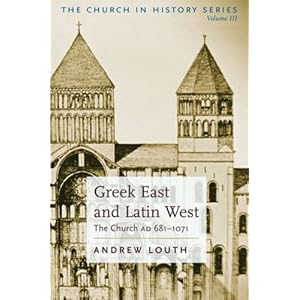
I hope this helps.
C.B. said:
"Are all doctrines past form the apostles or are some developed based on other things? Take the Trinity as an example...my understanding is that this was systematically formed based on heterodox attacks, but as a systematized doctrine it was new."
The western interpretations are different from the Eastern. Our interpretation has strong strong strong continuity with the pre-Nicene world. The same may not be true with some western interpretations. In my protestant years from 1997/1998 to about 2003 I use to follow David Bercot's online ministry/website. And so I use to believe in the pre-Nicene view of the doctrine of the Trinity. Yes, they did believe in the Father, the Logos(I said it this way for a reason), and the Holy Spirit. And yes, they saw all Three as Eternal and Divine. Now there are differences between the Nicene and Pre-Nicene views. I know what they are, but I don't want to go into much detail right now. For the past few months I have been talking about this very issue with an online friend. You can see it here.
Sorry, but I didn't want to repeat myself over here......eventhough I probably have, but yeah, I use to believe in the Pre-Nicene view. Now I believe in the Eastern Christian interpretation of the Nicene view. The core essence is the same. One of the main reasons why I chose to go East instead of Rome was because of this very issue. I knew that the pre-Nicene view was extremely close to the Eastern Christian Nicene understanding. Listen to this podcast by Fr. Thomas Hopko
The Holy Trinity
Also read what Pope Alexander of Alexandria had to say about the issue against the heretic Arius, and you will see that the doctrine is not new.......far far from it.
C.B. said:
"I guess as ideas and therefore doctinres evolve and heterodxies infiltrate and attack, the result can be conflicting traditions...at which point there must be some tie breaker? What is that?"
Read the primary sources for yourself. Yeah, it may take a few years, but it's worth it. I've been reading them off and on since 1997/1998. Read them for yourself and then decide what you think the tie breaker is. I Chose Antioch over Rome because of the doctrine of the Trinity. But for someone else it might be something different. A different issue.
I hope this helps.
[1]page 76, [2]page 82,[3] pages 102-103 from the book the first Seven Ecumenical Councils (325-787): Their History and Theology by Leo Donald Davis
Farrell on the West and the passing on of original guilt
Can we trust the Early Christians? And did they see Scripture as the sole standard of doctrine?
Tim said:
"I trust them to a point. I can’t just take whatever they say as truth, though."
So you are the deciding factor? I know you will say Scripture is, but you should know that when you say such things, I will naturally see you as being the deciding factor of what Scripture says and doesn't say......even if you feel otherwise.
Tim said: "Where did the church ORIGANLLY get all their doctrine before traditions?"
I know what you are trying to say for I use to be a Baptist. However, I see things differently now, and so the question you asked no longer makes sense to me, for all of it is Tradition......including Scripture itself. Scripture is an aspect of Tradition, it is not really separate from it. Nor is it the whole of it. It maybe the Primary aspect, but it's not the only aspect.
Tim said: "The Scriptures and direct apostolic tradition. Numbers are inconsequential. Just talk to Christopher Columbus."
If you believe it's Scripture and direct apostolic tradition, then how can you hold to Solo Scriptura?
Tim said: "Looking at the Scriptures alone, I just can’t see how you can see everything you hear taught now and equate it with what the apostles taught."
Do you believe in Sola Scriptura or Solo Scriptura? You seem to believe in Solo. It would seem as if all the talk of other authorities is nothing more than lip service. You don't really believe in other authorities.
Tim said: "But like I said, where did the church ORIGANLLY get all their doctrine before traditions? The Scriptures and direct apostolic tradition."
In the other thread about Head Coverings, do you believe what Paul said in Scripture to be binding today? If you say no, then I doubt if "direct apostolic tradition" really would matter to you since Scripture doesn't really matter to you. You pick and choose what you want from Scripture, and so Scripture is not really your final authority. You don't really believe in Scripture. You believe in yourself. You are the deciding factor. You are the boss. You make the decisions. You decide what is and isn't valid today in regards to Scripture. And thus, you are the real final authority. This is why you want to isolate Scripture from it's surrounding context. You isolate it because you want to be the one to determine what Scripture means, and you know that the Fathers disagree with you and so you don't want them to have a say. Either that or you don't want their say to really matter.
Tim said: "Since we only have the Scriptures as transfers of direct apostolic tradition,"
Says who? Do you believe all the people that sat at the Apostles feet got it wrong? Do you believe they all lost what the Apostles told them to keep? Do you believe they all got amnesia shortly after the death of the Apostles?
I'm sorry, but I don't believe this. I trust the prayer of Jesus in the Gospel of John.
Chapter 17 verse 20
“I do not pray for these alone, but also for those who will believe in Me through their word;"
Jesus prayed for those who would listen to the Apostles. I believe the next generation was faithful, and the ones who were not ......in regards to heresies.....we already know for they told us who the heretics were. Also Jesus said other things in other places that would support the idea that the visible Church that He started would still be around......it wouldn't go away, and it wouldn't fall into utter apostasy when the last Apostle died. And so yes I trust them. Why don't you?
Tim said: "the Scripture then become the sole standard of doctrine."
According to who? Do you believe in Solo Scriptura or Sola Scriptura? You seem to believe in Solo Scriptura.
What was the Sole standard of doctrine in the 1st century? It wasn't Sola Scriptura. They still had Jesus, the Apostles, and the council in Acts chapter 15 in the first century. Not only that, but the New Testament doesn't really tell much about how Christians worshiped. Surely they Worshiped, and surely the Apostles and other Apostolic men taught them how. So what about the second century?
Well let's look at Saint Polycarp:
The genuine tradition of Apostolic doctrine
Quote:
"Polycarpus (1) bp. of Smyrna, one of the most prominent figures in the church of the 2nd cent. He owes this prominence less to intellectual ability, which does not appear to have been pre-eminent, than to the influence gained by a consistent and unusually long life. Born some 30 years before the end of the 1st cent., and rasied to the episcopate apparently in early manhood, he held his office to the age of 86 or more. He claimed to have known at least one apostle and must in early life have met many who could tell things they had heard from actual disciples of our Lord. The younger generation, into which he lived on, naturally recognized him as a peculiarly trustworthy source of information concerning the first age of the Church. During the later years of his life Gnostic speculation had become very active and many things unknown to the faith of ordinary Christians were put forth as derived by secret traditions from the Apostles. Thus a high value was attached to the witness Polycarp could give as to the genuine tradition of apostolic doctrine, his testimony condemning as offensive novelties the figments of the heretical teachers. Irenaeus states (iii.3) that on Polycarp's visit to Rome his testimony converted many disciples of Marcion and Valentinus. Polycarp crowned his other services to the church by a glorious martyrdom." [1]
The third century?
Tertullian and Tradition/Observances/Customs not mentioned in Scrip...:
Quote:
"If, for these and other such rules, you insist
upon having positive Scripture injunction, you will find none. Tradition will be
held forth to you as the originator of them, custom as their strengthener, and
faith as their observer. That reason will support tradition, and custom, and
faith, you will either yourself perceive, or learn from some one who has.
Meanwhile you will believe that there is some reason to which submission is
due."
The next following centuries aren't your friend either.
And so, If they didn't go by your version of Sola Scriptura, then why should anyone abide by it today?
Tim said: "Is that not like the old days then?"
No, it's not. What the Apostles spoke was just as authoritative as what they wrote. I don't know if you do, but if you fight against modern Pentecostals, then I don't see how you can see yourself as copying the Apostles. Saint Peter had a vision about the gentiles, do you believe in visions? If not, then you can't say what you just said. Like I said before, you pick and choose what you wish to believe in. You pick and choose what you want to be binding in Scripture for today. Thus, you are the deciding factor. You are the final authority.
[1] page 846 from the book "A Dictionary of Early Christian Biography: A Reference Guide to over 800 Christian men and women, Heretics, and Sects of the first six centuries" edited by Henry Wace & William C. Piercy. Originally published in London 1911 by John Murray, republished by Hendrickson publishers 1999
The event went well
A lecture by Fr. Wilbur Ellsworth
This lecture was given last year at the Missions and Evangelism Conference in Grand Rapids, Michigan. The title of the speech was titled The Christian Reformed: Who are they?
I thought it was awesome.
Play Audio
Orthodoxy 102 Course To Be Offered On-Line January 31, 2011
Quote:
"JOHNSTOWN, PA --With The Blessing of His Eminence, Metropolitan Nicholas a seven-week on-line introductory class on the Orthodox Christian Spiritual Life, Orthodoxy 102, will begin on Monday January 31, 2011. The class, led by Fr. Peter Paproski, will be broadcast live each week from St. John the Baptist Orthodox Church in Stratford Connecticut. The class will begin at 7:00 pm and will last approximately 60 minutes.
Topics to be discussed will include, The Nature of the Church, Teachings of the Fathers on the Spiritual Life, Sin and Repantance: Combating the Passions and Training in the Virtues, Orthodox Worship, Faith and Works, Spiritual Life and the World.
Time will allowed at the end of each session for a question and answer period based on questions raised in person or via email or instant messaging. Audio recordings of each session will be archived for later study.
There is no charge for participating, however, those who wish to participate must register on-line to enter the class room and access the broadcast link. Audio recordings of each session will be archived for later study."
Please visit the website to read the rest or to register.
Too much caffeine
Why I reject the Western interpretations of Doctrinal Development
Thanks for the link. I'm pretty familiar with how Rome understands the issue of doctrinal development. I've known about the concept for sometime. I was aware of it way back in my protestant Baptist years, and I came to know of it even more in my Anglo-Catholic years. If you don't know, a man by the name of John Henry Newman had alot to do with not only the influence of the Oxford Movement, which put Anglo-Catholicism on the map, but he was also the one who came up with the Development of Doctrine idea. Also thanks to my inter-actions with David and my readings of the posts of his buddy Dr. Michael Liccione.......I can say that I'm pretty familiar with the Roman Catholic view/interpretation of the Development of Doctrine idea. Now one may run into Roman Catholics that may reject the idea.....I am not talking about them. I am only talking about the Roman Catholics that embrace the idea.
I also run into a number of conservative protestants who reject the idea and so I am not talking about those conservative protestants who reject it. I am only talking about the conservative ones who at least embrace the idea......like my PCA buddy Ricky.
And so with that said I will say that I reject both the Roman Catholic and protestant interpretations of the development of doctrine ideas. I listened to the first 4 videos from the link you gave. I was surprised that he was more open to things that other conservative protestants aren't open to. I appreciate that.
However, I must voice my dissent in regards to how the west seems to view "doctrinal development". In doing so I hope I am not being rude nor mean. These are the problems I see:
How can one embrace the Bible or what they may call Biblical Theology (in contrast to what they call Systematic Theology) while at the same time admit that what they believe about certain issues wasn't articulated until many many many centuries later?
To me that would mean either one of two things:
1.) Jesus, the Apostles, and the Church after them didn't articulate it, but someone many centuries later did?
If this is the case then one would have to assume that what you believe really isn't Biblical at all for it wasn't articulated until centuries later. What Did Jesus articulate? What did the Apostles articulate? And what did they pass on to the next generation? What did that generation and the generation after that articulate? Don't forget what the Apostle Paul said:
2 Thessalonians 2:15"Therefore, brethren, stand fast and hold the traditions which you were taught, whether by word or our epistle."
And what the Apostle Jude said:
Jude 1:3"...................I found it necessary to write to you exhorting you to contend earnestly for the faith which was once for all delivered to the saints."
And so to me, when it comes to Christianity, something was articulated by Jesus and the Apostles and they wanted that to be past on and held to. To say that your view wasn't articulated until many centuries later will tell me that what you believe isn't really Biblical. For how can you point to the Scriptures in support of that view if you know it came later in time? That's one problem I have with it. The other is:
2.) Both Jesus and the Apostles articulated it, but no one after them did until many centuries later.
This view seems to be the default view of most protestants I run into. Especially when one is cornered into a wall. One will have to play the Restorationist card in order to hold on to their belief. They would have to assume that Jesus and the Apostles taught what they did only for it to be lost for many centuries till the founder of their group or school of thought was born. Or else it would be extremely difficult to believe.....with a straight face.....that what you teach is what the Bible teaches.
Now, with that said I will say that I see the western views of doctrinal development as being one of "Macro-Evolution". The Eastern Christian view is what I would call "micro-Evolution".
What do I mean by this? Simple!
If Jesus, the Apostles, and the Church after them all taught and articulated the doctrine of Free Will. Then no matter what.......the doctrine centuries later must still be recognizable as being Free Will. The West turns what started out as Free Will and they turn it into either soft or hard determinism. This is what the west means by doctrinal development. And this is what I reject.
To the Christian East, if something starts out as a cat then no matter the evolution it must still look like some cat centuries later.....It doesn't matter if it's a wild cat, a mountain lion or a domesticated cat. It's still the same doctrinal and theological DNA.
The west turns what started out as a cat into a Lizard. This is what the west calls doctrinal development and this is what I reject.
I hope this helps! If I was rude or mean I am sorry. I didn't mean to be. Please let me know if I was rude.
Part 2:
As seen from Theologica.
Thanks once again for responding. In order for you to see how I feel, I think I must go into more detail as well as use more examples.
Free Will: Now I don't know if Free Will is an Essential or a non-Essential on your list:
1.) If Jesus, the Apostles, and the Early Church Fathers all articulated Free Will, then to me no matter the Evolution centuries later, the doctrine should still be recognizable as being the same animal. Now lets call the Free Will that Jesus, the Apostles, and the Early Church Fathers articulated as A Sabertooth Tiger.
What happened in the west through Saint Augustine is that Free Will was eventually tossed out the window in favor of a Plotinistic soft determinism. I would call this a Lizard. A totally different animal. Believe it or not, but many Pre-Nicene Christians articulated the Free Will view against the fatalistic and deterministic views of various gnostics, and pagans. And so we know what the animal of free will looks like. We also know what it looks like for Saint Augustine use to defend the doctrine in his early christian writings. And so we know what the animal looks like, but even more importantly, we know what Free Will doesn't look like.
The problem is that people use his debates with Pelagius as a means to overturn the old view(throwing the baby out with the bathwater). As a means to overturn or over rule the ancient view. They over turn it in favor of a more Deterministic view. They will say that with his debates with Pelagius we learned more and so now we are going to teach determinism. I am sorry but Determinism is a totally different animal than Free Will. Not only that, but no one notified the Christian East. The Christian East was still articulating the doctrine of Free Will.....just as we still do today! Now the Christian West did modify Saint Augustine's view through various local western councils......I know Rome will protest by calling them ecumenical. But to the Christian East they were western local councils. Arles in 473 A.D. and Second Orange in 529 A.D. and so officially the Christian West articulated various forms of semi or moderate Augustinianism. Hard Augustinianism was usually condemned. There are semi-Augustinian schools of thought within Rome that teach a recognizable form of Free Will. For our purposes we will call these cats a mountain Lion and a cheetah. There are other schools of thought within Rome that are more High Augustinian and so I would say that they still teach something that is more recognizable as a lizard. Now when Protestantism came about both Luther and Calvin articulated a form of high Augustinianism, and so they both were advocating different types of Lizards! The same with Jansen and Jansenism! I could be wrong, but I think the Anabaptists were advocates of Free Will, if so then lets call their view a wild Lion.
When Arminius came on the scene lets call his view a domesticated cat. The same with some Caroline Divines, some Nonjurors, and John Wesley within Anglicanism. All different forms of domesticated cats.
Let's call the Pelegius view as well as some of the later Arminians through Charles Finney a type of wild human eating Lion.
And let's call the Orthodox Christian view a Tiger. This is how I see the whole scenario.
I feel the same way in the area of other views as well.
The Christian west turned the Ransom and Christus Victor views of the Atonement into either Satisfaction(Saint Anselm) or Penal Substitution(mostly within various Reformed traditions, and the traditions of those that split from them). The later views are different animals to me. It's Macro-Evolution!
We still teach Christus Victor! But it's seen as Heresy now to the later views! Our Atonement understanding and some of the western ones are different animals.
I feel the same is true even in the area of Ecclesiology and other issues. I'm sorry for the rant, and for my generalizations of the west. I know that not everyone in the west believes the same nor go about the same issue the same way, but this is how I see it in more detail. The ideas seem like two different animals to me.
Blogs: Eastern Orthodox
-
-
Why Not Use Ancient Rites?6 years ago
-
-
When Everyone Is Watching4 months ago
-
-
-
It’s Time to Say Goodbye4 years ago
-
About the Mystagogy Resource Center3 months ago
-
-
Orthodox Life15 years ago
-
-
Resurrection Sunday 20265 months ago
-
-
The End of This Work10 months ago
-
-
The end of Pious Fabrications12 years ago
-
-
Bending Toward Bethlehem2 years ago


Blogs: Oriental Orthodox
-
-
Restoration of The Son10 years ago


Blogs: Roman Catholic
-
-
-
-
-
-
A Brief Update12 years ago
-
-
-
My Sister's New Blog15 years ago
-


Blogs: Anglo-Catholic/ACNA
-
Faking a Bundle1 week ago
-
Hello world!2 years ago
-
-
-


Blogs: Lutheran Protestant
-
Test3 days ago
-
-
-


Blogs: Mostly Arminian Protestant
-
Book Review: Grace for All10 years ago
-
-
Denah Rumah Type 36 Luas Tanah 728 years ago
-
Christian Rappers and Collaborations15 years ago
-
-
-
-
-
-
-
-
-
-
NOT Independence Sunday17 years ago
-


Blogs: Reformed Protestant
-
-
Do Not Disavow2 years ago
-
-
This Blog Has Moved!!!12 years ago
-
-
Is Peter the Rock of the Church?16 years ago
-
-


